

When we talk about skincare, our attention naturally drifts to new ingredients and treatments.
But if we look at the skin from a longer perspective, the conversation surprisingly returns to two basic elements. Water and sunlight.
To be precise, it is about keeping the water the skin already has, and reducing unnecessary exposure to UV rays. It seems simple, but it is an important starting point for understanding skin health and aging.
Keeping water in the skin is more important than trying to fill it
Looking from a broader perspective, life originally began in water. As creatures living in the sea moved onto land, the very first challenge they faced was dryness. If the skin dries out of water, survival becomes difficult.
Thus, the skin has evolved from the start as a barrier to protect water, and human skin is on that same continuum.
The core of that barrier is the outermost layer of the skin, the stratum corneum. While it is often easily dismissed as something to be removed, a healthy stratum corneum blocks external irritation and holds moisture inside.
It is a structure where skin cells are stacked like bricks, and lipids like ceramides fill the gaps like cement. If this structure is weakened, transepidermal water loss increases, allowing moisture inside the skin to leak out.
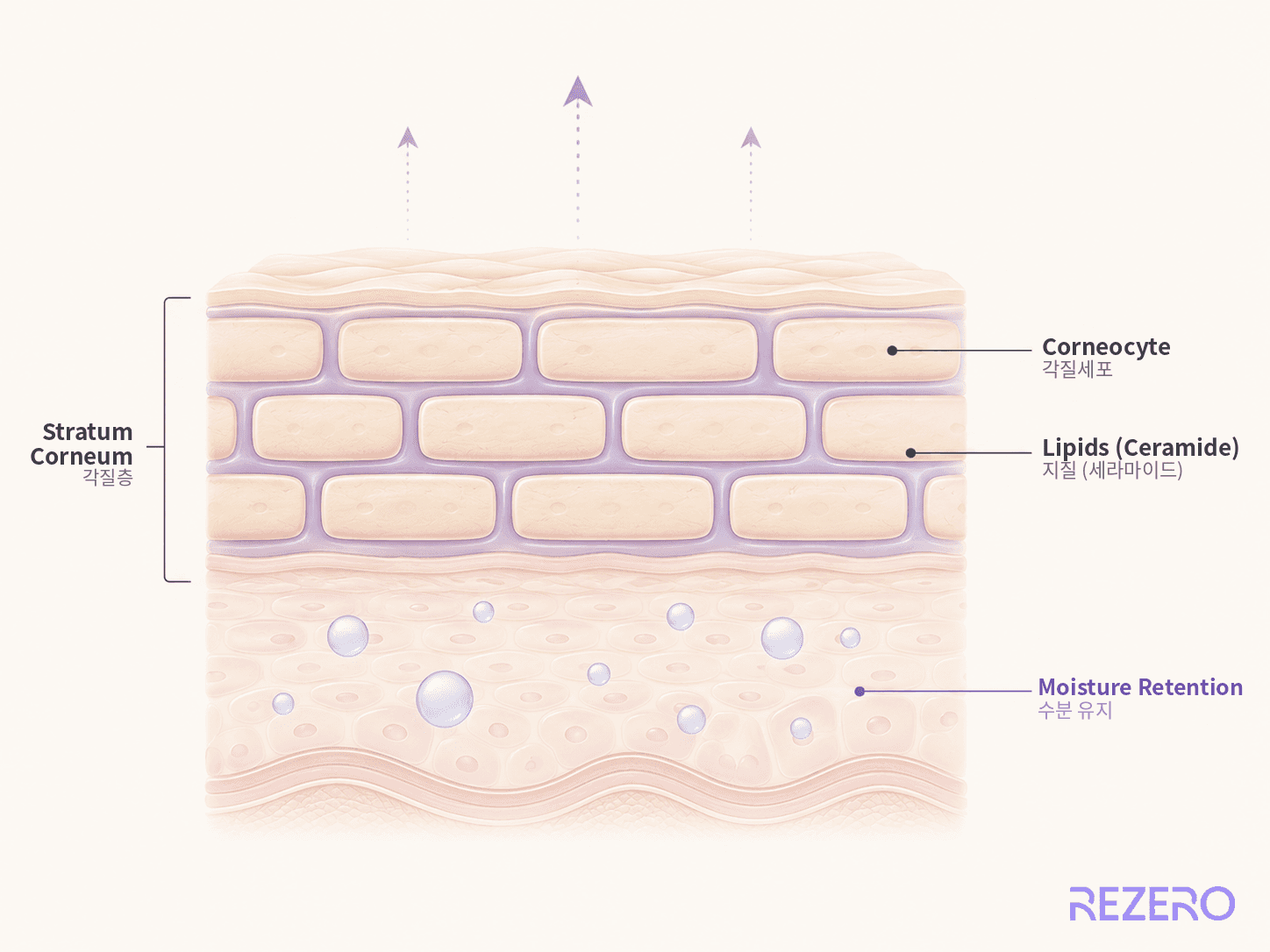
Structure of the skin barrier: brick-and-cement arrangement of skin cells and lipids
Therefore, when it is dry, whether the skin is in a condition to hold onto water is more important than simply putting water on the surface.
Habits like frequent and harsh cleansing, excessive exfoliation, and repeatedly using unsuitable cosmetics can burden this barrier. Conversely, proper moisturizing is closer to a process of helping the skin keep its existing moisture from escaping easily, rather than blindly filling it with water.
Will drinking a lot of water improve your skin then?
It is easy to think that drinking a lot of water will instantly make the skin moist and reduce wrinkles, but it is difficult to draw such a conclusion based on research so far.
There are small-scale studies showing that when people who usually drink little water increase their intake, the moisture level of the stratum corneum increases slightly. However, due to limitations in scale and methodology, there is no standard saying a certain number of liters a day will improve it.
What matters is the body's natural water balance.
While repeatedly enduring thirst or replacing water entirely with coffee and drinks is hard to recommend, forcing yourself to drink a lot is not the answer. Drinking according to your activity level and environment, while managing the skin barrier to keep that moisture inside, is a more accurate way to look at it.
Another crucial element for the skin is sunlight
If moisture management is a matter of the barrier, sunlight is connected to the process of the skin changing over time.
Our bodies also have protective mechanisms. Pigments inside skin cells sit like umbrellas above the cell nuclei, protecting them from UV rays.
UV rays are that much of a long-standing stimulus.
Sunlight contains UV rays of various wavelengths. UVA reaches the deep layers of the skin and can affect the connective tissue of the dermis, while UVB is involved in surface damage.
The changes that appear from being exposed to UV rays over such a long period are called photoaging.
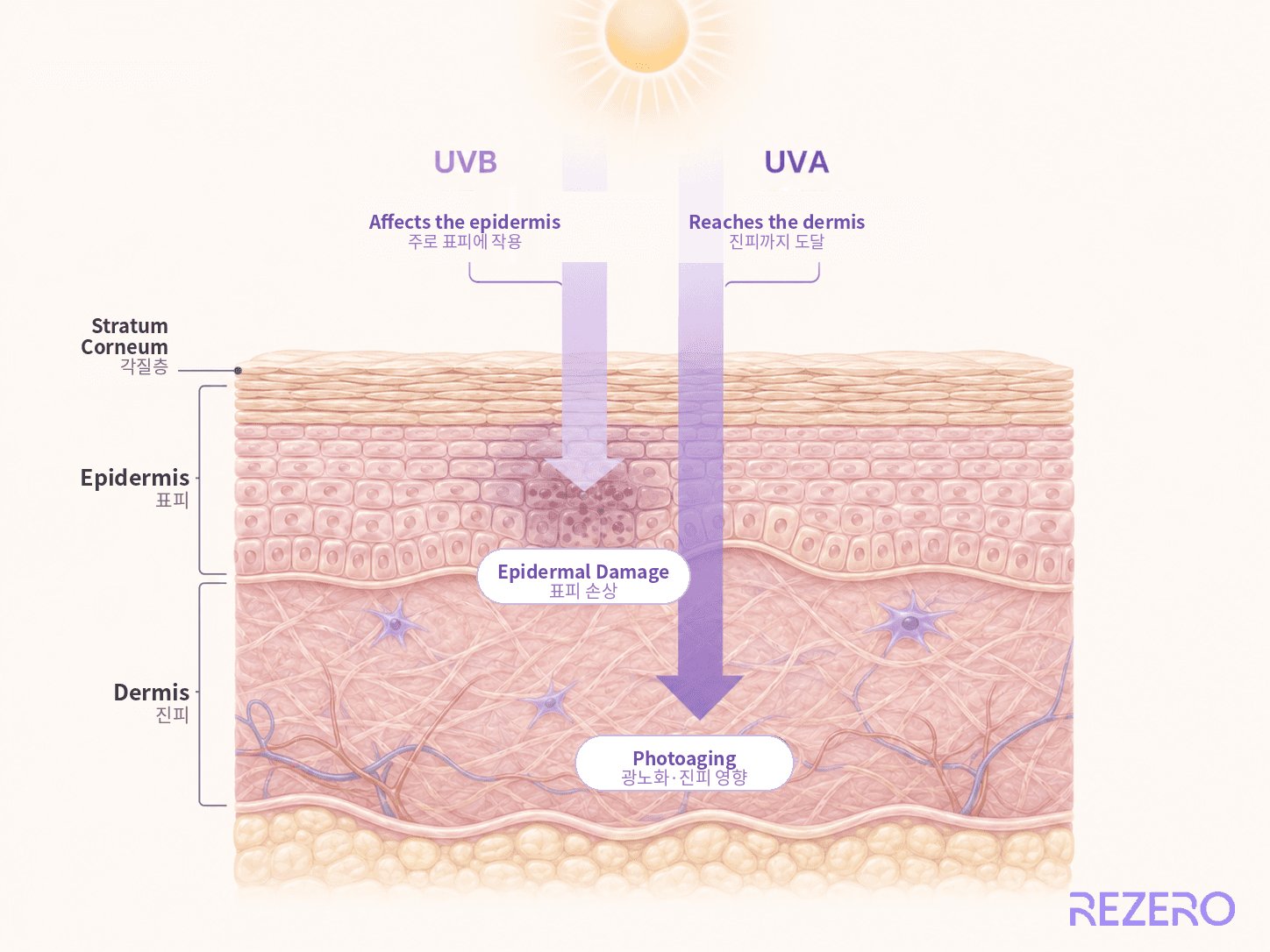
Penetration depth of UV rays: UVB reaches the epidermis, UVA reaches the dermis
Loss of elasticity, increased wrinkles and pigmentation, and uneven skin tone are caused not only by changes that come with age, but also by the cumulative effects of UV rays.
And this impact does not only build up on days with severe sunburn. Even on cloudy days, a significant portion of UV rays still reaches us, and since UVA passes through glass windows, the inside of a car or a window side is no exception.
Such exposure is repeated over countless days. That is why UV protection is not for special days, but a matter of daily habits.
What should we take care of in our daily lives then?
You do not need a grand routine. During dry seasons like winter, simply maintaining indoor humidity with a humidifier can help the skin lose less moisture.
Gently adding moisture before sleep, such as with a sheet mask, is also a simple method you can try without burden.
Sun protection does not end with a single product. It is best to first reduce direct sunlight during peak hours and make use of shade, hats, and clothing.
For exposed skin, a broad-spectrum sunscreen that blocks both UVA and UVB is helpful. The American Academy of Dermatology also recommends applying a broad-spectrum sunscreen of SPF 30 or higher on skin not covered by clothes, and reapplying about every two hours when outdoors.
Sunscreen does not need to be expensive. The criteria are that it contains no harmful ingredients, applies well, and above all, does not cause trouble when applied to your skin.
Conversely, you do not absolutely have to apply it on days spent entirely indoors where barely any sunlight enters.
Daily skincare as envisioned by Rezero Clinic
When we think of skincare, we often look for things to add. We add good ingredients, new products, and if necessary, the help of treatments. Of course, there are moments when such methods are needed.
But observing the skin over a long time often leads to one thought.
Healthy skin is indeed the result of adding many good things, but it is also the result of losing less of what it originally had.
Therefore, daily skincare as envisioned by Rezero Clinic does not start with a complicated routine. It is about hydrating as much as suits you, managing gently so the skin can keep that moisture, and not taking daily sunlight lightly.
You might not feel a big difference in a day or two. But skin is made of the sum of time, not just a single day.
As much as you worry about what to add today, thinking about what to lose less of in the future. That might be the most basic way to start slow aging.

Liệu trình liên quan
skin care
Liệu trình liên quan
skin care
Chăm sóc tin cậy, hiệu quả bền lâu
Chăm sóc tin cậy, hiệu quả bền lâu
Rezero Clinic
Địa chỉ
Tầng 2, 61 Sincheon-daero 50beon-gil, Busanjin-gu, Busan
Bác sĩ đại diện
Son Tae-bong
Mã số kinh doanh
344-21-02387
Điện thoại
051-715-7227
Opening Hours
Normal
Mon
10:30 - 19:30
Wed
10:30 - 19:30
Fri
10:30 - 19:30
Late
Tue
10:30 - 21:00
Thu
10:30 - 21:00
Early
Sat
10:30 - 15:00
Sun
10:30 - 15:00
Break
13:00 - 14:00

© 2026, Rezero. All rights reserved.
Designed by HSF
When we talk about skincare, our attention naturally drifts to new ingredients and treatments.
But if we look at the skin from a longer perspective, the conversation surprisingly returns to two basic elements. Water and sunlight.
To be precise, it is about keeping the water the skin already has, and reducing unnecessary exposure to UV rays. It seems simple, but it is an important starting point for understanding skin health and aging.
Keeping water in the skin is more important than trying to fill it
Looking from a broader perspective, life originally began in water. As creatures living in the sea moved onto land, the very first challenge they faced was dryness. If the skin dries out of water, survival becomes difficult.
Thus, the skin has evolved from the start as a barrier to protect water, and human skin is on that same continuum.
The core of that barrier is the outermost layer of the skin, the stratum corneum. While it is often easily dismissed as something to be removed, a healthy stratum corneum blocks external irritation and holds moisture inside.
It is a structure where skin cells are stacked like bricks, and lipids like ceramides fill the gaps like cement. If this structure is weakened, transepidermal water loss increases, allowing moisture inside the skin to leak out.
Structure of the skin barrier: brick-and-cement arrangement of skin cells and lipids
Therefore, when it is dry, whether the skin is in a condition to hold onto water is more important than simply putting water on the surface.
Habits like frequent and harsh cleansing, excessive exfoliation, and repeatedly using unsuitable cosmetics can burden this barrier. Conversely, proper moisturizing is closer to a process of helping the skin keep its existing moisture from escaping easily, rather than blindly filling it with water.
Will drinking a lot of water improve your skin then?
It is easy to think that drinking a lot of water will instantly make the skin moist and reduce wrinkles, but it is difficult to draw such a conclusion based on research so far.
There are small-scale studies showing that when people who usually drink little water increase their intake, the moisture level of the stratum corneum increases slightly. However, due to limitations in scale and methodology, there is no standard saying a certain number of liters a day will improve it.
What matters is the body's natural water balance.
While repeatedly enduring thirst or replacing water entirely with coffee and drinks is hard to recommend, forcing yourself to drink a lot is not the answer. Drinking according to your activity level and environment, while managing the skin barrier to keep that moisture inside, is a more accurate way to look at it.
Another crucial element for the skin is sunlight
If moisture management is a matter of the barrier, sunlight is connected to the process of the skin changing over time.
Our bodies also have protective mechanisms. Pigments inside skin cells sit like umbrellas above the cell nuclei, protecting them from UV rays.
UV rays are that much of a long-standing stimulus.
Sunlight contains UV rays of various wavelengths. UVA reaches the deep layers of the skin and can affect the connective tissue of the dermis, while UVB is involved in surface damage.
The changes that appear from being exposed to UV rays over such a long period are called photoaging.
Penetration depth of UV rays: UVB reaches the epidermis, UVA reaches the dermis
Loss of elasticity, increased wrinkles and pigmentation, and uneven skin tone are caused not only by changes that come with age, but also by the cumulative effects of UV rays.
And this impact does not only build up on days with severe sunburn. Even on cloudy days, a significant portion of UV rays still reaches us, and since UVA passes through glass windows, the inside of a car or a window side is no exception.
Such exposure is repeated over countless days. That is why UV protection is not for special days, but a matter of daily habits.
What should we take care of in our daily lives then?
You do not need a grand routine. During dry seasons like winter, simply maintaining indoor humidity with a humidifier can help the skin lose less moisture.
Gently adding moisture before sleep, such as with a sheet mask, is also a simple method you can try without burden.
Sun protection does not end with a single product. It is best to first reduce direct sunlight during peak hours and make use of shade, hats, and clothing.
For exposed skin, a broad-spectrum sunscreen that blocks both UVA and UVB is helpful. The American Academy of Dermatology also recommends applying a broad-spectrum sunscreen of SPF 30 or higher on skin not covered by clothes, and reapplying about every two hours when outdoors.
Sunscreen does not need to be expensive. The criteria are that it contains no harmful ingredients, applies well, and above all, does not cause trouble when applied to your skin.
Conversely, you do not absolutely have to apply it on days spent entirely indoors where barely any sunlight enters.
Daily skincare as envisioned by Rezero Clinic
When we think of skincare, we often look for things to add. We add good ingredients, new products, and if necessary, the help of treatments. Of course, there are moments when such methods are needed.
But observing the skin over a long time often leads to one thought.
Healthy skin is indeed the result of adding many good things, but it is also the result of losing less of what it originally had.
Therefore, daily skincare as envisioned by Rezero Clinic does not start with a complicated routine. It is about hydrating as much as suits you, managing gently so the skin can keep that moisture, and not taking daily sunlight lightly.
You might not feel a big difference in a day or two. But skin is made of the sum of time, not just a single day.
As much as you worry about what to add today, thinking about what to lose less of in the future. That might be the most basic way to start slow aging.
Liệu trình liên quan
skin care
Liệu trình liên quan
skin care
Chăm sóc tin cậy, hiệu quả bền lâu
Chăm sóc tin cậy, hiệu quả bền lâu
Rezero Clinic
Địa chỉ
Tầng 2, 61 Sincheon-daero 50beon-gil, Busanjin-gu, Busan
Bác sĩ đại diện
Son Tae-bong
Mã số kinh doanh
344-21-02387
Điện thoại
Giới thiệu
Câu chuyện
Không gian phòng khám
Giới thiệu bác sĩ
Đường đi đến đây
Opening Hours
Normal
Mon
10:30 - 19:30
Wed
10:30 - 19:30
Fri
10:30 - 19:30
Late
Tue
10:30 - 21:00
Thu
10:30 - 21:00
Early
Sat
10:30 - 15:00
Sun
10:30 - 15:00
Break
13:00 - 14:00
© 2026, Rezero. All rights reserved.
Designed by HSF